AI startups are everywhere right now. Every week there’s a new platform claiming to “revolutionize workflows,” “unlock intelligence,” or “transform enterprise operations with next-generation AI.
And yet… most people still have absolutely no idea what these companies actually do.
Ironically, some of the most technically advanced startups in the world have the weakest messaging. Their products may be brilliant. Their founders may be brilliant. But their GTM? Often painfully unclear.
At Launchera, we see this constantly when reviewing startup websites, pitch decks, and GTM strategies. The issue usually isn’t the product itself. It’s positioning, messaging, and clarity.
Or, put another way:
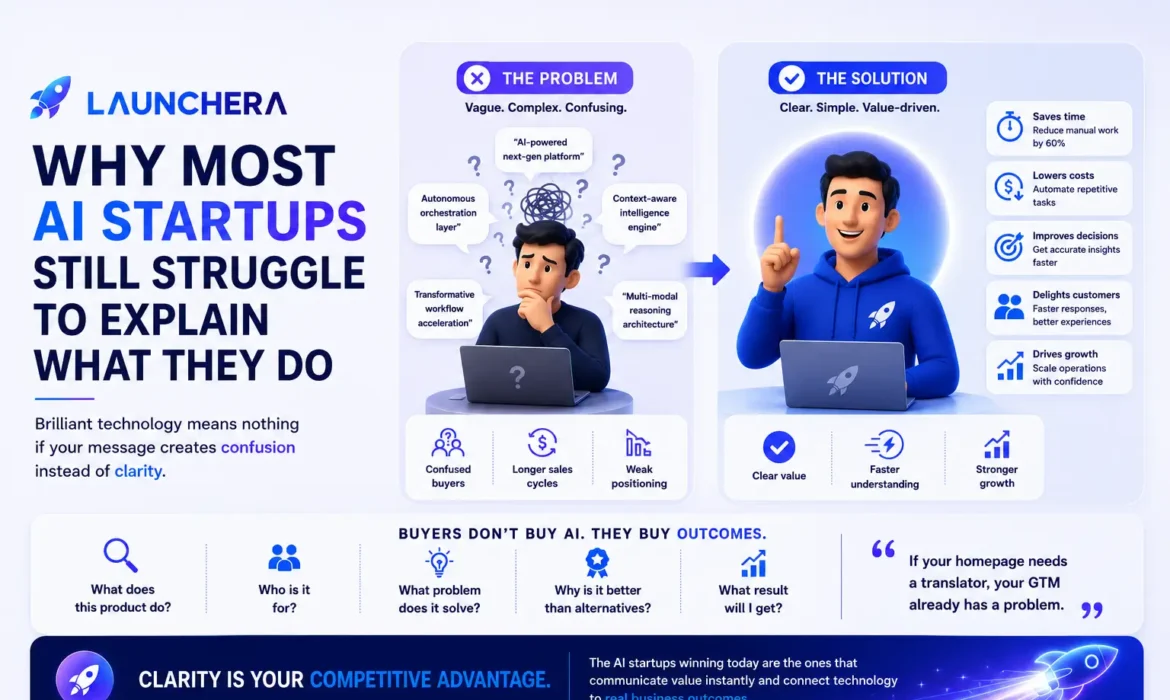
If your homepage needs a translator, your GTM already has a problem. When a prospect has to ask what you offer, clearly something is wrong with your positioning.
Jay Cameron
Founder & PMM
The AI Buzzword Epidemic
Today’s AI landscape is drowning in vague language.
The problem is that many AI startups write messaging to sound intelligent instead of understandable. Somewhere along the way, founders started believing complexity equals credibility. It doesn’t.
Buyers don’t care how sophisticated your neural architecture is if they can’t quickly answer:
What does this product do?
Who is it for?
What problem does it solve?
Why is it better than alternatives?
If prospects need three demos, a glossary, and emotional support just to understand your homepage, you’ve already lost momentum.
200
New AI startups per day
“AI-Powered” is No Longer Differentiation
In 2022, saying your platform used AI felt innovative.
In 2026? Congratulations. So does everyone else.
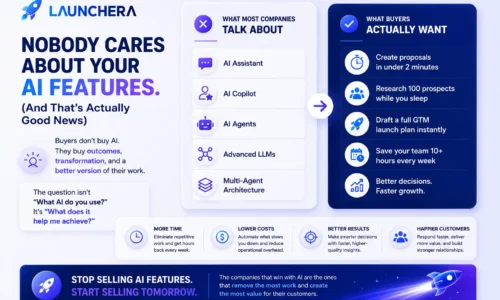
AI has rapidly become table stakes. Buyers now assume intelligent automation is built into modern software. Simply saying “AI-powered” no longer separates you from the market.
What buyers actually care about is:
What outcome does the AI create?
How does it save time or money?
Does it reduce friction?
Does it improve decision-making?
Is it measurable?
The strongest AI companies don’t sell AI itself. They sell the business transformation AI enables.
That’s a major difference.
The Real Problem: Category Confusion
One of the biggest GTM issues facing AI startups is category confusion.
Many founders try so hard to sound disruptive that they invent entirely new categories nobody understands.
The result? Confused buyers. Longer sales cycles. Weak positioning. And messaging that feels abstract instead of actionable.
Sometimes the smartest GTM move is actually making your category simpler, not more revolutionary.
You don’t always need to invent a category. Sometimes you need to explain your wedge into an existing one.
Because buyers don’t purchase what they don’t understand.
Technical Complexity is Not Customer Value
Founders love features. Customers love outcomes.
That’s the disconnect.
Many AI startups lead with technical sophistication:
LLM orchestration
Context graph architectures
Agentic workflow intelligence
Multi-modal reasoning layers
Meanwhile the customer is sitting there wondering: “Cool… but does this actually help my team?”
The best product marketing translates complexity into business value.
Try: “Get answers instantly without digging through spreadsheets and Slack threads.”
Clarity wins. Every time.
AI Startups Need Product Marketing Earlier Than Ever
One of the biggest mistakes AI startups make is waiting too long to invest in product marketing.
Founders often assume: “We’ll figure out messaging later.” “We just need more features first.” “The product will speak for itself.”
It won’t.
In crowded AI markets, the startups that win are often not the ones with the best technology—they’re the ones that explain their value the fastest.
This is where experienced PMMs become critical.
A strong PMM helps AI startups:
Clarify positioning
Simplify messaging
Define ideal customer profiles
Build compelling GTM narratives
Translate technical complexity into buyer language
Differentiate in saturated markets
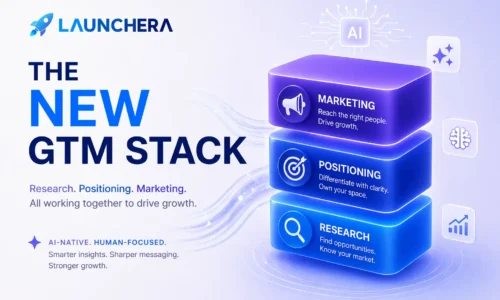
And increasingly, PMMs are using AI themselves to accelerate market research, competitive analysis, messaging validation, and campaign optimization.
The best GTM teams today are becoming AI-native.
Final Thoughts
AI is transforming every industry—but many AI startups are still struggling with one very human problem: communication.
The future belongs to companies that can simplify complexity, communicate value instantly, and build GTM strategies that connect technology to real business outcomes.
Because no matter how advanced your product is, if the market can’t understand it… it can’t buy it.
And in today’s AI race, clarity may be the most important competitive advantage of all.