W e’ve reviewed dozens of AI startup websites, product demos, pitch decks, and go-to-market strategies. From founders building their first MVP to more established SaaS companies adding AI to mature products, we’ve noticed the same mistake repeatedly.
They spend more time explaining their AI than explaining why anyone should care.
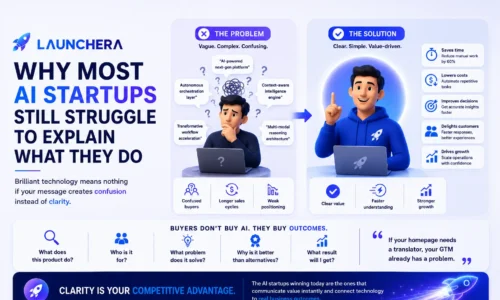
Their homepages proudly promote AI assistants, autonomous agents, proprietary models, intelligent orchestration, retrieval-augmented generation, and context-aware workflows. The technology may be impressive, but the customer value is often buried beneath a mountain of terminology.
The irony is hard to miss. Some of the smartest technical teams in the world are building products that are incredibly difficult for buyers to understand.
That isn’t a technology problem. It’s a GTM problem. The sooner AI companies understand this, the faster they can turn technical innovation into commercial traction.
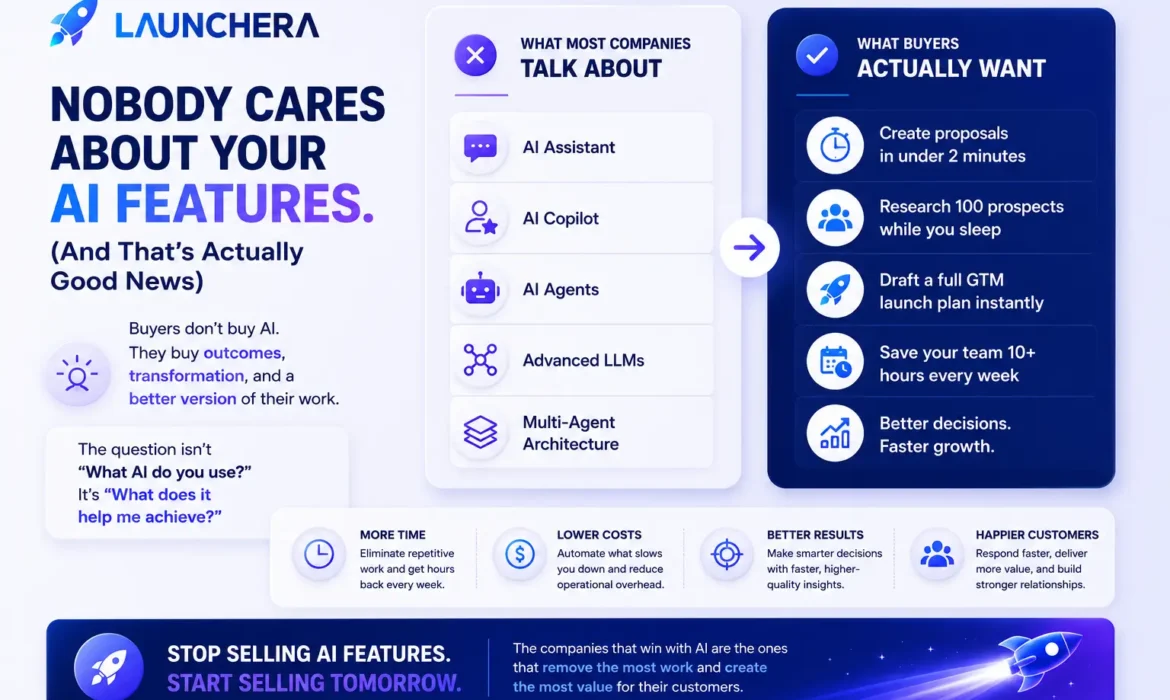
Buyers don't buy artificial intelligence or 'agents'. They buy real-world outcomes. The buy solutions that solve their problems.

The AI Gold Rush Has Created a Messaging Problem
Every software company now needs an AI story. Every startup is introducing an assistant, copilot, agent, workspace, or intelligent layer. Every product roadmap seems to include an AI feature, even if the team is still working out what it should actually do.
As a result, calling your product “AI-powered” no longer creates meaningful differentiation. A few years ago, it sounded innovative. Today, it sounds like the minimum requirement for joining the conversation.
AI is following the same path as cloud computing. There was a time when companies proudly marketed themselves as cloud-based. Eventually, the cloud became expected infrastructure rather than the central value proposition.
AI is heading in the same direction. Buyers will increasingly assume that intelligent automation is built into modern software. They won’t ask whether you use AI. They’ll ask what your product helps them accomplish.
That’s the conversation your messaging needs to lead.
The AI Feature Trap
Imagine you’re evaluating two software vendors.
The first tells you that its platform uses large language models, multi-agent orchestration, retrieval-augmented generation, autonomous workflows, and advanced contextual reasoning.
Everything it says may be technically accurate. But unless you’re selecting AI infrastructure, those terms don’t help you understand whether the product is worth buying.
The second vendor says:
“Turn three hours of customer research into ten minutes of actionable insight.”
Which conversation gets your attention?
Exactly.
One vendor is describing its technology. The other is describing your future.
The first makes the buyer do the work of translating features into value. The second makes the value immediately obvious.
Great product marketing doesn’t force buyers to decode the product. It helps them picture a better version of their work.
Nobody Wants AI. They Want Their Time Back.
One of the biggest misconceptions in software is that customers are actively shopping for artificial intelligence.
They usually aren’t.
Customers wake up thinking about unanswered leads, overloaded teams, missed deadlines, repetitive administrative work, slow research, inconsistent messaging, and pressure to deliver more with fewer resources.
They are looking for better ways to solve those problems. AI may power the solution, but it is rarely the outcome they are purchasing.
Nobody wakes up hoping to buy another dashboard, assistant, or agent. They want to respond to leads faster, understand customers better, create stronger campaigns, shorten sales cycles, and give their teams more time to focus on valuable work.
AI is the mechanism.
The improvement in their work is the product.
Why Technical Teams Build Incredible Products—and Complicated Messaging
Founders and engineers naturally enjoy explaining how their products work. They’ve spent months or years solving difficult technical challenges, designing complex systems, and building capabilities that might not have been possible only a few years ago.
They should be proud of that work.
But customers don’t buy technical effort. They buy what changes after the product is implemented.
That creates a natural disconnect. Product teams talk about models, architecture, integrations, and technical capabilities. Buyers think about time, money, productivity, growth, and risk.
Experienced product marketers bridge that gap. Their role is not to remove the technical sophistication from the product. It is to translate that sophistication into a value story that a customer can understand, remember, and repeat.
AI companies rarely have a shortage of technical detail. What they often have is a translation problem.
The Rise of AI Feature Inflation
Every company seems to be introducing its own version of an AI Assistant, AI Copilot, AI Workspace, AI Studio, or AI Agent.
These names may have once sounded differentiated. Now, they are becoming increasingly interchangeable.
When every company uses the same language, the terminology loses its power. Buyers are left comparing a collection of products that all sound intelligent, autonomous, and revolutionary—but often fail to explain what they actually accomplish.
The question buyers care about is not:
“Do you have an AI Agent?”
It is:
“What work no longer needs to be done manually because of it?”
Can it research 100 target accounts overnight? Can it turn customer interviews into a positioning brief? Can it create a personalised proposal before a competitor has finished writing the follow-up email? Can it respond to every inbound lead while the sales team is asleep?
That is where differentiation begins.
Don’t just give your AI a name. Give it a job.
Stop Marketing Features. Start Marketing Workflows.
One of the most important shifts in AI product marketing is moving from feature-led messaging to workflow-led messaging.
Instead of saying: “Our platform includes an AI Assistant.”
Say: “Turn every customer meeting into a polished action plan before the call ends.”
Instead of saying: “We use autonomous AI agents.”
Say: “Research 100 target accounts overnight and start your morning with prioritised opportunities ready for outreach.”
Instead of saying: “Powered by advanced large language models.”
Say: “Respond to every inbound customer question in seconds instead of adding another ticket to the queue.”
Instead of saying: “Our solution provides AI-powered content generation.”
Say: “Create a week of on-brand campaign content before your first meeting of the day.”
The difference is simple. One version describes the software. The other describes life after buying it.
Customers purchase the second one.
AI Assistants and AI Agents Aren’t the Same Thing
Another common messaging issue is using the terms assistant and agent interchangeably.
They represent different levels of value.
An AI Assistant helps someone complete work. It answers questions, summarises information, generates drafts, and supports decision-making.
An AI Agent goes further. It performs work on someone’s behalf. It gathers information, coordinates steps, triggers actions, interacts with systems, and delivers a completed output for review.
An assistant might help a marketer write a campaign brief. An agent might analyse customer research, identify the most important themes, draft the brief, prepare channel-specific messaging, and route the materials to the right people for approval.
That is not just a smarter interface. It is a different way of getting work done.
The most compelling agent messaging will not focus on how intelligent the agent is. It will focus on the amount of work it completes.
Don’t just market intelligence. Market execution.
Human-in-the-Loop is a Competitive Advantage
Much of the AI conversation focuses on complete autonomy. The assumption is that the best AI will operate independently and remove people from the process entirely.
For many business workflows, that isn’t what customers want.
They want AI to accelerate research, analyse information, prepare recommendations, create first drafts, execute repeatable tasks, and coordinate complex processes. But they still want people making important decisions, applying context, and remaining accountable for the outcome.
A marketing leader may want AI to produce five campaign concepts. They probably don’t want it spending the entire quarterly budget without approval.
A sales leader may want AI to research accounts and draft personalised outreach. They probably don’t want it promising a custom product feature to a strategic prospect.
A founder may want AI to build a first version of the company’s positioning. They still need an experienced person to challenge the assumptions and decide whether the story truly represents the business.
Human oversight is not a limitation. It is what turns AI-generated activity into responsible, strategic execution.
The best AI does not replace judgment. It gives people better information and more time to apply it.
AI has made product marketing more important, not less. The technology generates content and intel — PMMs create clarity."
Why Product Marketing Matters More in the AI Era
The rise of AI has made experienced product marketing more valuable, not less.
As products become increasingly sophisticated, companies need people who can turn technical complexity into customer understanding. They need clear positioning, differentiated messaging, defined buyer personas, compelling use cases, market validation, launch strategy, sales enablement, and a narrative that connects the product to a real business problem.
That is the work of product marketing.
PMMs also know how to use AI to accelerate their own work. They can synthesise customer interviews, analyse competitor messaging, identify market trends, test narrative directions, draft campaign variations, and uncover patterns faster than traditional research methods allow.
But AI does not automatically know which insight matters, which positioning is credible, or which message will resonate with a specific buyer.
That still requires experience, judgment, context, and a strong understanding of the market.
The future does not belong to AI replacing product marketers. It belongs to AI-enabled product marketers outperforming teams that still treat AI as a faster search engine or copy generator.
The GTM Lesson for AI Founders
If you are building an AI product, don’t lead with the technology. Lead with the transformation.
Don’t sell: “An AI-powered proposal platform.”
Sell: “Create a personalized, customer-ready proposal in under two minutes.”
Don’t sell: “Autonomous sales intelligence agents.”
Sell: “Start every morning with your highest-potential accounts researched and prioritized.”
Don’t sell: “AI-driven customer insight analysis.”
Sell: “Turn dozens of customer interviews into clear product and positioning priorities in minutes.”
Don’t sell: “Generative AI campaign optimization.”
Sell: “Launch more campaign variations, learn what works faster, and stop wasting budget on messages that don’t convert.”
Your model, agent, and architecture may be important reasons your product can deliver the result. They are rarely the result itself.
Technology explains how.
Outcomes explain why.
How Launchera Helps AI Companies Tell Better Stories
At Launchera, we work with AI startups and B2B SaaS companies that have built strong products but struggle to explain their value clearly.
The challenge is rarely a lack of features. It is often unclear positioning, broad audiences, generic AI language, inconsistent messaging, and too much emphasis on how the technology works.
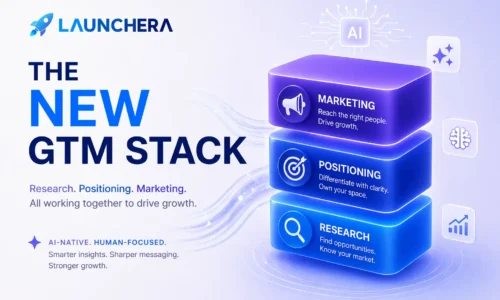
We combine experienced product marketing leadership with AI-accelerated research to help companies define their ideal customer, sharpen their positioning, communicate differentiated value, and build practical GTM strategies.
That means moving beyond feature lists and vague claims. It means creating a story that connects technical capabilities to the business outcomes buyers genuinely care about.
Because great GTM is not about making your product sound more intelligent.
It is about making the value easier to understand.
Final Thoughts
Artificial intelligence is changing software faster than almost any previous technology. Yet one principle remains unchanged: customers do not buy technology for the sake of technology.
They buy time, productivity, revenue, confidence, better decisions, and a more effective version of their work.
AI is simply one way of delivering those outcomes.
So stop asking whether your messaging explains the sophistication of your technology. Start asking whether it clearly explains what becomes faster, easier, or more valuable for your customer.
Stop selling the model.
Stop selling the assistant.
Stop selling the agent.
Start selling tomorrow.
Because buyers don’t care how intelligent your software is. They care how much better it makes them.